Website promotion
Free directories to submit and promote your website in 2026
Where to submit your website, SaaS or mobile app for free, how to prepare a useful listing, and how to measure visits without chasing ranking promises.
Start with the right audience, not the longest directory list
Launching a website does not automatically give people a way to discover it. A relevant directory listing can provide another route to your site, particularly when readers are already browsing for a service, an app or a useful resource. The important word is relevant: a carefully written listing in the right category is usually a better use of your time than submitting the same generic description to dozens of unrelated websites.
This guide focuses on two free submission options in our own network: DirectBacklinks for general websites, and FreeSaaSList for SaaS products and mobile apps. It is not an independent ranking of every directory on the web. We explain the difference, what to prepare and what to check after submitting so that you can decide whether either option fits your project.
A directory link is a discovery opportunity, not a promise of search rankings. Google decides which pages to crawl and index, and a listing may generate no visits at all. Make your own website useful and trustworthy first; treat directories as one part of a broader promotion plan.
Two free submission options, two different purposes
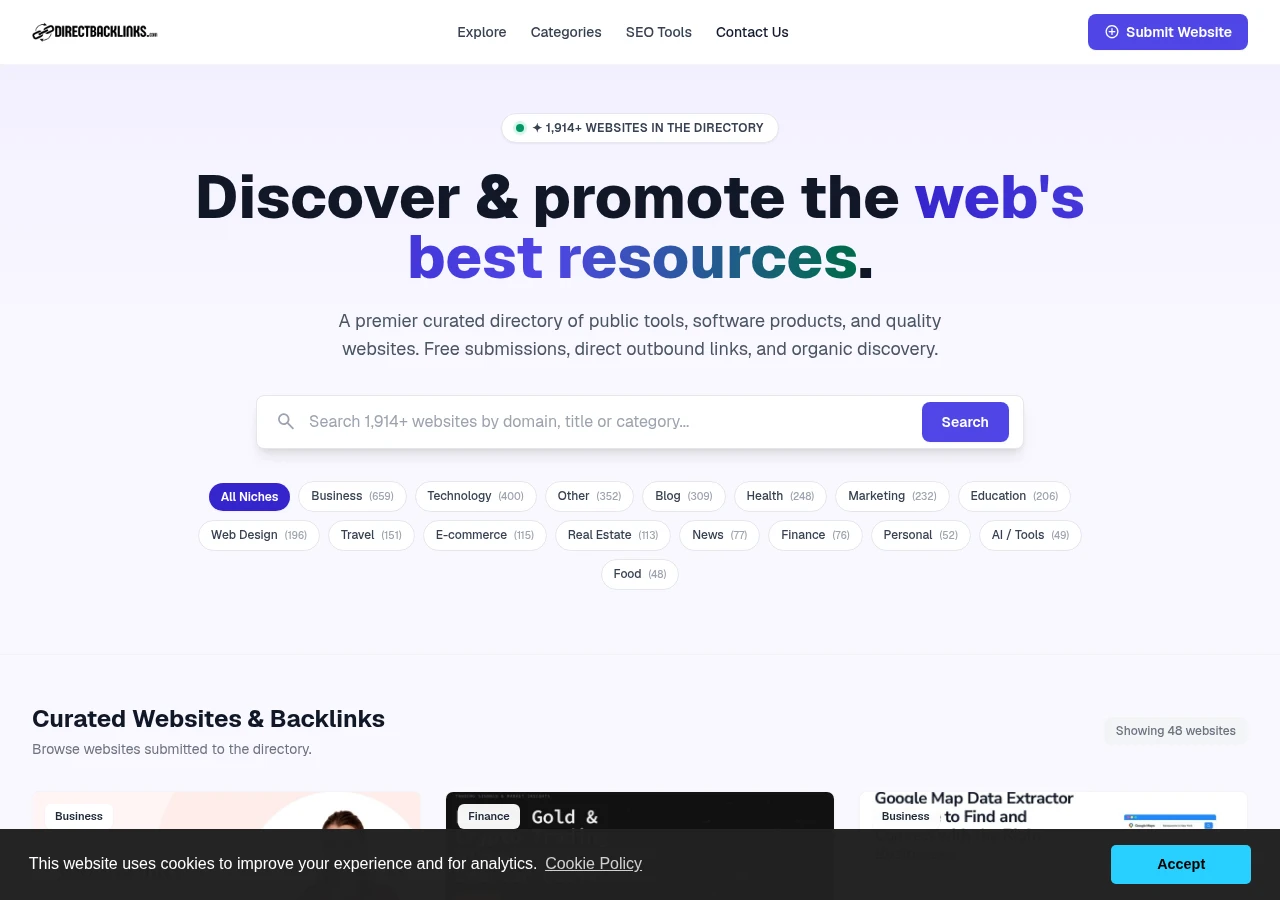
DirectBacklinks is a general website directory. It is the more natural starting point for a blog, an online shop, a local business, a personal website or another resource that is not primarily a software product. Its homepage includes categories such as Business, Technology, Education and Marketing, helping visitors browse by subject rather than by product format.
FreeSaaSList is focused on software discovery. Use its SaaS submission form for a web-based software product, and its separate mobile app submission form for an iOS or Android app. A software listing belongs in a software directory because visitors are more likely to understand what the product does and compare it with other tools.
Both directories accept submissions for free. On FreeSaaSList, reviews are free and equal for all creators; payment is not a way to skip or accelerate review. Before sending anything, read the current form and provide the details it asks for. Submission is not a guarantee that a project will be accepted.
Submitting a general website to DirectBacklinks
Open DirectBacklinks and choose Submit Website. Use your final public website address, rather than an admin page, a temporary preview or a login-only link. Choose the categories that describe the actual subject of the site. A travel blog should not be labelled as a technology product simply because it runs on a website builder.
Write a title that people recognise and a description that explains what they will find. For example, a budgeting website could describe its calculators, guides and intended audience instead of saying it is the best finance platform in the world. Specific information helps a visitor decide whether to click; unsupported superlatives do not.
The screenshot below shows the directory's search and category browsing as captured on 25 November 2026. Counts and listings will change. DirectBacklinks can display website thumbnails, but the captured appearance of your site is not something you should rely on as your only explanation of its purpose. Your title, category and description still need to make sense on their own.
Submitting a SaaS product or mobile app to FreeSaaSList
For a SaaS product, prepare the product name, its public website, a concise description and the most relevant category. Describe the job your tool performs. A scheduling product, for example, could explain who books the appointments and how the tool reduces back-and-forth, rather than listing every feature or using vague language about productivity.
For a mobile app, use the dedicated app form and provide the store information and screenshots requested there. App store pages and a software website are different destinations: make it clear whether someone is visiting a web tool or installing an app. Screenshots should show the actual experience, not features that have not been released.
Check your claims before submitting. If your product supports only English, do not describe it as multilingual. If only part of the service is free, explain that accurately instead of implying that every feature is free forever. A truthful, current description is more useful to a potential user than a longer but misleading one.
A practical checklist before you submit
First, open your website in a private browsing window and on a phone. Make sure a new visitor can see what you offer without needing an account just to read the homepage. Check that the main action works, that important text is readable and that your contact information is accurate. A directory cannot compensate for a broken or confusing destination.
Second, prepare one consistent public URL. Use the address your website treats as its main version. Avoid submitting multiple versions with different tracking parameters, spelling variations or unnecessary trailing paths. If you already have a listing, find it before sending another submission; duplicate entries do not create extra value for readers.
Third, write a short description around three facts: what the website does, whom it helps and what someone can do when they arrive. Keep a copy with your logo and screenshots so you can reuse accurate details elsewhere. Finally, proofread the exact information in the form, including language support, pricing claims and store links, before pressing submit.
Measure visits rather than assuming a backlink worked
Once a listing is live, check that the link opens the correct destination. In your analytics, look for the referring website and landing pages associated with visits. Privacy tools, consent settings and browsers can affect attribution, so an analytics report may not identify every visitor. A handful of clicks is also too small a sample to make confident predictions.
DirectBacklinks adds a ref=directbacklinks parameter to outgoing links. That parameter can help identify the destination URL used, but it is not the same as UTM campaign tagging and does not automatically become a named campaign in Google Analytics. Use referral reports where available, or a specifically configured report for landing URLs, rather than assuming the parameter alone proves the source of every visit.
Keep a simple record of where you submitted, when the listing appeared and whether it led to meaningful actions such as a trial, an enquiry or a download. Page views, visits and submissions are different measurements. Judge the value of a listing by what people actually do on your site, not only by a public directory counter.
What to do after your first listing
Share your project where it answers a real question: a relevant community discussion, a helpful tutorial or a practical comparison. Follow each community's rules about promotion. Posting the same link repeatedly or trying to bypass a forum's limits can damage trust and lead to removal; a directory listing is not permission to spam.
Continue improving your own website with examples, clear documentation and content that addresses your audience's problems. You can also evaluate other launch platforms or niche directories, but check their current eligibility, costs and community rules before treating them as free submission options. Terms can change, and different platforms serve different stages of a project.
For a general website, start by exploring DirectBacklinks. For a software product or mobile app, use the matching FreeSaaSList form. One accurate listing in an appropriate place is a sensible first step. Sustainable discovery still depends on a useful product, honest information and promotion that respects the people you want to reach.
Editorial disclosure: FreeSaaSList and DirectBacklinks are part of the same network. No search ranking, indexing or traffic outcome is guaranteed.